
The future of heavy-duty EV charging is not just plugging into the grid. It is generating your own power, storing it, and keeping trucks moving no matter what.
Solar-powered truck charging is redefining how freight operators keep their fleets on the road. Electric trucks are no longer a concept on a whiteboard. They are hauling goods across California and beyond right now. But as more Class 8 battery-electric trucks hit the road, a critical question keeps coming up: where does all the power come from?
The grid is part of the answer, but it is not the whole answer. Utility interconnections can take years to complete, demand charges can spike operating costs, and grid outages can bring an entire fleet to a standstill. That is why the most forward-thinking charging depot operators are turning to solar-powered microgrids to build energy independence, cut costs, and keep trucks rolling even when the grid cannot.
At WattEV, we are not waiting for the grid to catch up. We are building it ourselves.
What Is a Charging Depot Microgrid (and Why Does It Matter)?
A microgrid is a self-contained energy system that can operate independently from the main power grid. In a truck charging context, that typically means combining on-site solar generation, battery energy storage systems (BESS), and smart energy management software into a single integrated system that powers charging infrastructure directly.
Think of it this way: instead of relying 100% on your local utility to deliver the megawatts your depot needs, you are producing a significant portion of that energy right where the trucks are parked. Solar panels generate clean electricity during the day, batteries store excess energy for later use, and when the sun goes down or the grid goes offline, the depot keeps running.
For heavy-duty freight operations where downtime means missed deliveries and lost revenue, that kind of resilience is not optional. It is essential.
The Grid Gap: Why Solar-Powered Charging and Storage Are Not Just Nice-to-Haves
Across California and much of the U.S., fleet operators looking to electrify face a frustrating reality: the grid simply is not ready in many locations. Utility upgrades and new interconnections can take two to five years to complete. For a fleet operator that needs charging capacity now, that timeline is a dealbreaker.
Solar-powered truck charging through on-site microgrids solves this problem by putting power generation at the point of use. Instead of waiting on utilities to build out new substation capacity, depot operators can install solar arrays and battery storage to begin charging operations while grid upgrades happen in parallel.
But the benefits go well beyond speed-to-market. Here is what solar microgrids deliver for charging depot operators:
Demand Charge Management
High-voltage truck chargers create significant demand spikes on the grid, and utilities charge a premium for those peaks. A depot that draws several megawatts during peak hours can see demand charges that dwarf actual energy costs. On-site battery storage acts as a buffer, absorbing solar energy during the day and discharging it during peak demand windows to flatten those costly spikes.
Time-of-Use Rate Optimization
California utilities impose steep time-of-use rates during afternoon and evening hours when the grid is under maximum stress. With solar generation peaking during the middle of the day and batteries storing that excess, depot operators can shift their heaviest charging loads to periods when on-site power is abundant and grid prices are lowest.
Grid Outage Protection
California has seen increasing grid disruptions due to wildfire mitigation shutoffs, extreme weather events, and aging infrastructure. For a freight depot, a multi-hour grid outage can mean dozens of trucks sitting idle instead of hauling loads. A microgrid with battery backup can island from the grid and continue operating, keeping critical charging loads powered when the grid cannot.
Lower Levelized Cost of Energy
Solar energy has zero marginal fuel cost once panels are installed. When you combine that with battery storage and intelligent charge management, the overall levelized cost of energy at a depot can drop significantly compared to drawing entirely from the grid, especially in regions with high utility rates.
WattEV’s Approach: Solar Microgrids in Action
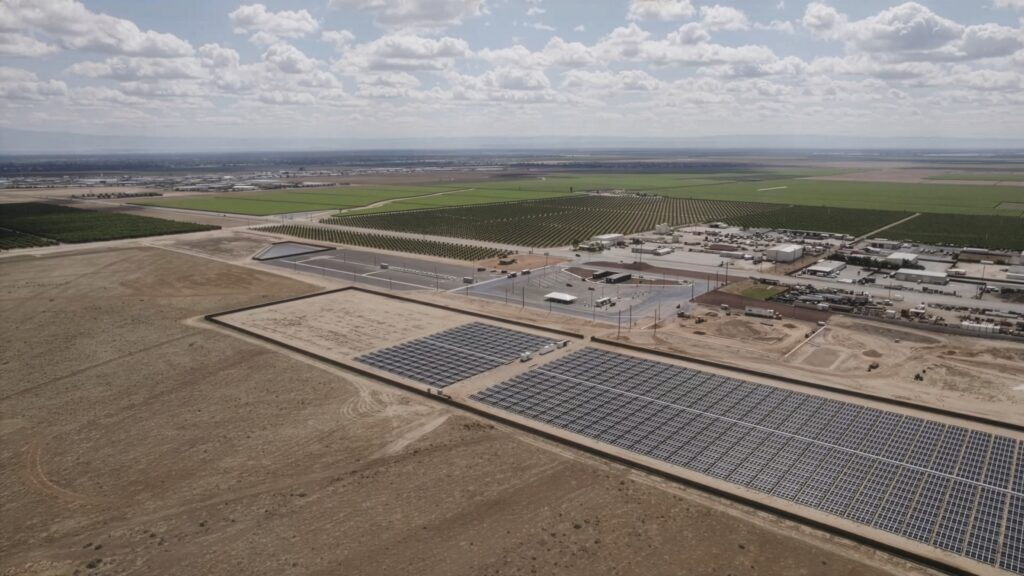
WattEV opened the world’s first electric truck stop powered by a solar microgrid with battery energy storage at our 119-acre Bakersfield, California, depot. The site features 5 MW of on-site solar capacity today, with room to scale to 25 MW as demand grows. That solar array feeds directly into our Megawatt Charging System (MCS) chargers, which can deliver up to 1,200 kW per truck and cut charging dwell time to under 30 minutes for 300 miles of range.
As WattEV CEO Salim Youssefzadeh has explained, the Bakersfield facility operates a fully islanded set of chargers that run on nothing but solar and battery storage, completely independent of the utility grid. That is not a theoretical proof of concept. It is a working freight depot serving real trucks on real routes connecting the San Joaquin Valley to California’s ports.
The Bakersfield depot sits at the junction of the CA-99 and CA-65 freight corridors, connecting the country’s most productive agricultural region to seaports in Long Beach and Los Angeles. It is part of WattEV’s growing network of charging depots across California, with additional solar-powered facilities expanding across the West Coast into Oregon and Washington.
Every future WattEV depot is being designed with MCS charging and solar microgrid integration, because we believe distributed energy generation is not just a nice add-on. It is the foundation of reliable, cost-effective truck charging at scale.
The Industry Is Moving Toward Distributed Energy
WattEV is not alone in recognizing the value of solar-powered truck charging through microgrids. Across the heavy-duty EV industry, fleet operators and infrastructure developers are increasingly pairing on-site solar and storage with their charging installations. The economics are compelling: research shows that managed charging alone can reduce charging costs by up to 30%, and layering on-site solar and battery storage can drive savings even further. In solar-rich regions like California, solar panels now cost as little as $1.50 per watt after incentives for commercial systems.
The trend is accelerating in 2026. Over 72% of planned U.S. grid additions through 2030 are solar, storage, or microgrid systems, signaling that distributed energy is no longer an alternative approach. It is becoming the backbone of modern energy infrastructure. For EV charging in particular, on-site generation addresses the specific challenges that make grid-only solutions impractical: interconnection delays, demand charge exposure, and the need for uninterrupted power at remote or high-demand locations.
As one industry expert put it, the energy system is shifting from centralized to distributed, and electric vehicles are the use case that makes it real.
What Fleet Operators Should Consider
If you are a fleet operator or logistics company exploring truck electrification, here are a few things to keep in mind when evaluating charging infrastructure:
- Understand your utility timeline. Before committing to a grid-only charging strategy, get a clear estimate from your utility on interconnection timelines and costs. If the answer is two-plus years, on-site generation may be the faster path to getting trucks on the road.
- Model your demand charges. High-power truck charging creates big demand spikes. Run the numbers on what those peaks will cost you monthly, and compare that against the capital cost of battery storage that can flatten those peaks.
- Think about resilience. Grid outages are not hypothetical. If your operation depends on trucks being charged and ready to roll every morning, backup power is not a luxury. It is a business continuity requirement.
- Plan for scale. Design your depot site with future solar and storage expansion in mind. WattEV’s Bakersfield site dedicates 100 of its 119 acres to solar, with only 25% currently deployed. Building in room to grow means you are not stuck retrofitting later.
- Explore available incentives. Federal investment tax credits, state grants from agencies like the California Energy Commission, and local air district funding can significantly offset the capital costs of solar and storage installations.
The Road Ahead: Solar-Powered Truck Charging Infrastructure That Powers Itself
The transition to zero-emission freight is happening. California’s Advanced Clean Fleets regulation is driving adoption, and the economics of electric trucking are increasingly competitive with diesel when total cost of ownership is factored in. But the infrastructure has to keep pace with the trucks, and that means building charging depots that are as reliable, resilient, and cost-effective as possible.
Solar-powered truck charging through on-site microgrids is not a futuristic vision. It is operational today at WattEV’s Bakersfield depot and expanding across our network. These systems reduce dependence on utility timelines, cut operating costs, protect against grid disruptions, and produce cleaner energy at the point of use.
For fleet operators ready to electrify, the question is not whether you need resilient charging infrastructure. It is whether you can afford not to have it.
Ready to future-proof your fleet’s charging infrastructure?
WattEV is building the nation’s first solar-powered freight charging corridors across California and the west coast. Learn how our Truck-as-a-Service model and microgrid-powered depots can keep your fleet moving. Visit wattev.com or contact our team to get started.